MariaDB Master/Master GTID based Replication with keepalived VIP
Sat, 2017-11-11 11:29 —
Shinguz
Important: FromDual does NOT recommend to use an automated VIP failover technology as described below for a MariaDB/MySQL Master/Master Replication. In such a topology we recommend a manual VIP failover with prepared scripts!
Some of our customers still want to have old-style MariaDB Master/Master Replication Clusters. Time goes by, new technologies appear but some old stuff still remains.
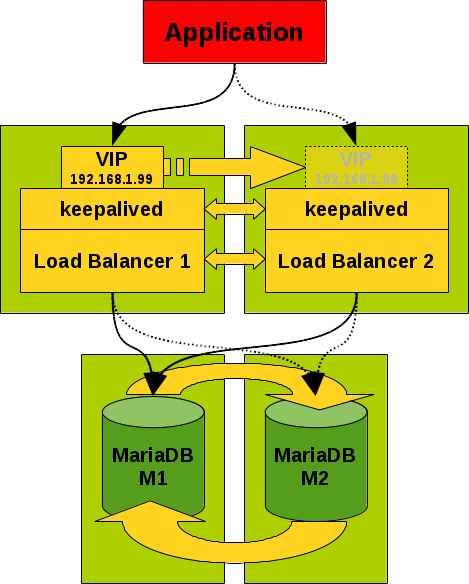
The main problem in a Master/Master Replication set-up is to make the service highly available for the application (applications typically cannot deal with more than one point-of-contact). This can be achieved with a load balancer (HAproxy, Galera Load Balancer (GLB), ProxySQL or MaxScale) in front of the MariaDB master/master replication cluster. But the load balancer by it-self should also become highly available. And this is typically achieved by a virtual IP (VIP) in front of one of the load balancers. To make operations of the VIP more handy the VIP is controlled by a service like keepalived or corosync.
Figure 1: MariaDB Master/Master replication set-up with load balancer and keepalived
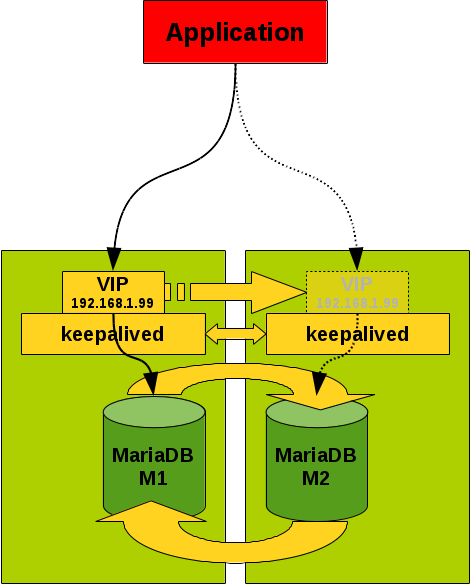
Because I like simple solutions (I am a strong believer in the KISS principle) I thought about avoiding the load balancer in the middle and attach the VIP directly to the master/master replication servers and let them to be controlled by keepalived as well.
Figure 2: MariaDB Master/Master replication set-up with keepalived
Important: A master/master replication set-up is vulnerable to split-brain situations. Neither keepalived nor the master/master replication helps you to avoid conflicts and in any way to prevent this situation. If you are sensitive to split-brain situations you should look for Galera Cluster. Keepalived is made for stateless services like load balancers, etc. but not databases.
Set-up a MariaDB master/master replication cluster
Because most of the Linux distributions have a bit old versions of software delivered we use the MariaDB 10.2 repository from the MariaDB website:
#
# /etc/yum.repos.d/MariaDB-10.2.repo
#
# MariaDB 10.2 CentOS repository list - created 2017-11-08 20:32 UTC
# http://downloads.mariadb.org/mariadb/repositories/
#
[mariadb]
name = MariaDB
baseurl = http://yum.mariadb.org/10.2/centos7-amd64
gpgkey=https://yum.mariadb.org/RPM-GPG-KEY-MariaDB
gpgcheck=1
For the MariaDB master/master replication set-up configuration we use the following parameters:
#
# /etc/my.cnf
#

[mysqld]

server_id                = 1           # 2 on the other node
log_bin                  = binlog-m1   # binlog-m2 on the other node
log_slave_updates        = 1

gtid_domain_id           = 1           # 2 on the other node
gtid_strict_mode         = On

auto_increment_increment = 2
auto_increment_offset    = 1           # 2 on the other node

read_only                = On          # super_read_only for MySQL 5.7 and newer
Important: In my tests I got crashes and core dumps with keepalived which disappeared after a full upgrade of CentOS 7.
Configuring keepalived
The most important part is the keepalived configuration file:
#
# /etc/keepalived/keepalived.conf
#
global_defs {
notification_email {
root@localhost
dba@example.com
}
notification_email_from root@master1 # master2 on the other node
smtp_server localhost 25
router_id MARIADB_MM
enable_script_security
}
Health checks
vrrp_script chk_mysql {
script "/usr/sbin/pidof mysqld"
weight 2 # Is relevant for the diff in priority
interval 1 # every … seconds
timeout 3 # script considered failed after … seconds
fall 3 # number of failures for K.O.
rise 1 # number of success for OK
}
vrrp_script chk_failover {
script "/etc/keepalived/chk_failover.sh"
weight -4 # Is relevant for the diff in priority
interval 1 # every … seconds
timeout 1 # script considered failed after … seconds
fall 1 # number of failures for K.O.
rise 1 # number of success for OK
}
Main configuration
vrrp_instance VI_MM_VIP {
state MASTER # BACKUP on the other side
interface enp0s9 # private heartbeat interface
priority 100 # Higher means: elected first (BACKUP: 99)
virtual_router_id 42 # ID for all nodes of Cluster group
debug 0 # 0 .. 4, seems not to work?
unicast_src_ip 192.168.56.101 # Our private IP address
unicast_peer {
192.168.56.102 # Peers private IP address
}
192.168.1.99/24 dev enp0s8 # public interface for VIP
}
Check health of local system. See vrrp_script above.
track_script {
chk_mysql
# If File /etc/keepalived/failover is touched failover is triggered
# Similar can be reached when priority is lowered followed by a reload
chk_failover
}
shell> ip link set enp0s9 down
shell> ip link set enp0s9 up
Problems
Problems we faced during set-up and testing were:
SElinux/AppArmor
Firewall
Keepalived controlling 2 virtual IPs
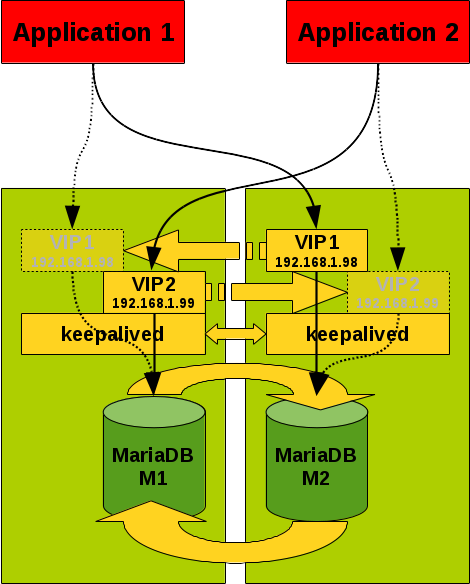
A second scenario we wanted to build is a MariaDB master/master GTID based replication cluster with 2 VIP addresses. This is to achieve either a read-only VIP and a read/write VIP or to have half of the load on one master and half of the load on the other master:
Figure 3: MariaDB Master/Master replication set-up with keepalived and 2 VIPs
For this scenario we used the same scripts but a slightly different keepalived configuration:
#
# /etc/keepalived/keepalived.conf
#
global_defs {
notification_email {
root@localhost
dba@example.com
}
notification_email_from root@master1 # master2 on the other node
smtp_server localhost 25
router_id MARIADB_MM
enable_script_security
}
Health checks
vrrp_script chk_mysql {
script "/usr/sbin/pidof mysqld"
weight 2 # Is relevant for the diff in priority
interval 1 # every … seconds
timeout 3 # script considered failed after … seconds
fall 3 # number of failures for K.O.
rise 1 # number of success for OK
}
vrrp_script chk_failover {
script "/etc/keepalived/chk_failover.sh"
weight -4 # Is relevant for the diff in priority
interval 1 # every … seconds
timeout 1 # script considered failed after … seconds
fall 1 # number of failures for K.O.
rise 1 # number of success for OK
}
Main configuration
vrrp_instance VI_MM_VIP1 {
state MASTER # BACKUP on the other side
interface enp0s9 # private heartbeat interface
priority 100 # Higher means: elected first (BACKUP: 99)
virtual_router_id 42 # ID for all nodes of Cluster group
unicast_src_ip 192.168.56.101 # Our private IP address
unicast_peer {
192.168.56.102 # Peers private IP address
}