Skip navigation.
Home

Languages

RSS Feed FromDual on Linked In Recommend us on Xing Join us on Facebook Google+ Flickr Contact us

replication

Migrating from MySQL Master-Master Replication to Galera Multi-Master Replication

Introduction

Galera is a synchronous Multi-Master Replication for MySQL. It is therefore in competition with several other MySQL architectures:

Building Galera Replication from Scratch

Introduction

MySQL/Galera synchronous Multi-Master Replication consists of 2 parts:

Galera - Synchronous Multi-Master Replication Cluster for MySQL/InnoDB

Galera features

Galera provides the following features:

  • Synchronous replication
  • Active/active multi-master topology
  • Read and write to any cluster node
  • Automatic membership control, failed nodes drop from the cluster
  • Automatic node joining
  • True parallel row level replication
  • Direct client connections
  • Drop-in replacement for native MySQL

Galera benefits

Benefits using Galera Replication:

  • High Availability
  • No slave lag

Be cautious when using Virtualized System with your Database

A customer rose a support case with a problem on his Master-Master set-up. The 2nd Master claims to have a problem:

master2> SHOW SLAVE STATUS\G
                ...
    Master_Log_File: master1-bin.000014
Read_Master_Log_Pos: 97975045
   Slave_IO_Running: No
  Slave_SQL_Running: Yes
Exec_Master_Log_Pos: 97975045
      Last_IO_Errno: 1236
      Last_IO_Error: Got fatal error 1236 from master when reading data from binary log:
                     'Client requested master to start replication from impossible position'

What has happened?

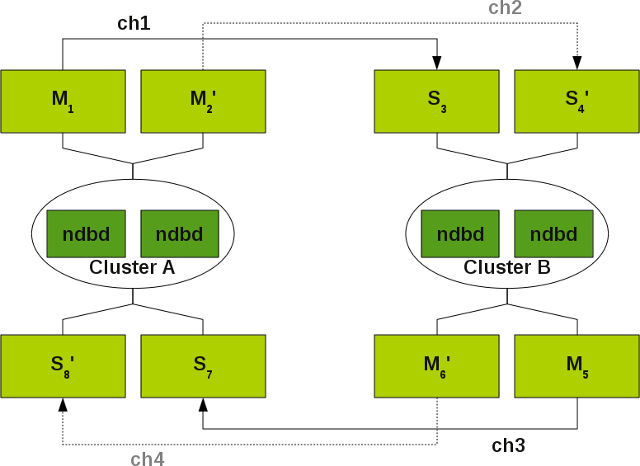
MySQL Cluster - Cluster Ring-Replikation mit 2 Replikations-Kanälen

Vor ein paar Tagen hatte ich wieder einmal mit einer MySQL Cluster Replikation zu tun. Ich habe das schon eine Weile nicht mehr angelangt und war somit vorbereitet, wieder einmal ein paar Überraschungen zu erleben.

Diejenige, für welche MySQL Cluster - Cluster Ring-Replikationen das tägliche Brot ist, können diesen Artikel getrost überspringen. Alle anderen können möglicherweise von unseren Erfahrungen profitieren.

Wir hatten das folgende MySQL Cluster Konstrukt im Einsatz:

MySQL Cluster - Cluster circular replication with 2 replication channels

A few days ago I had to deal with MySQL Cluster replication. I did not do this for a while so I was prepared to expect some interesting surprises once again.

For those who MySQL Cluster - Cluster circular replication is the daily business they may skip this article. For all the others they possibly can profit from our learnings.

I am talking about the following MySQL Cluster set-up:

FromDual Premium Support

What you get

  • 1st and 2nd level Support for MySQL, Percona Server and MariaDB.
  • Support via remote login (ssh) or Teamviewer and contact over phone, email, Skype or other instant messaging solutions.
  • We offer several different Support Levels with fast initial response times:

MySQL Multi-Master – Single-Slave – Replication (Episode 2)

Introduction

One of the features that make MySQL so great is its easy replication set-up. If you are experienced and know-how to do it, it takes you about 15 minutes to set-up a slave. What you have in the end is a replication from one master to one or several slaves.

Active/active fail over cluster with MySQL Replication

Electing a slave as new master and aligning the other slaves to the new master

In a simple MySQL Replication set-up you have high-availability (HA) on the read side (r). But for the master which covers all the writes (w) and the time critical read (rt) there is no HA implemented. For some situations this can be OK.

My thoughts about MySQL (Cluster) replication

According to Johans wishes I write down my concerns about MySQL (Cluster) replication. These items are things I run again and again into it with customers:

  • SQL-nodes are still loosing too easy connection to cluster after data node or management node restart (which leads into gaps, see next point). Automatic fail over or reconnection is just a dream (maybe it works in about 90% of the cases at least).

MySQL Multi-Master - Single-Slave - Replication

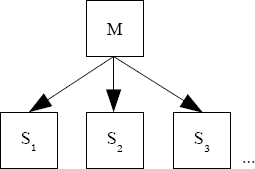
MySQL provides its replication for High Availability (HA) and for read Scale-out. Generally it is known that in a MySQL replication you can only replicate from one Master to many slaves. In this paper it is shown how a set-up can look like to replicate from two masters to one slave.

Caution: Handle this information with care!!!

Syndicate content